
AI IPOs: Where Do We Go from Here?
The 10% Chance
Imagine you had an extraordinarily talented child. A child with the potential to lift your entire family out of poverty and completely transform your future. But there was a catch: like in a game of “double or nothing” there was also a 10% chance that, in pursuing that potential, the child could end up killing the whole family.
Now imagine that child was about to gain access to the family savings — giving them vastly more resources to develop their abilities, move faster and become even more powerful.
What would you do?
It is an extreme analogy, but it captures something uncomfortable about the moment we are approaching with AI. Some of the world’s most powerful AI companies are moving towards public markets, potentially giving them access to even greater pools of capital. At the same time, fundamental questions around safety, governance and control remain unresolved.
IPOs: Where do we go from here
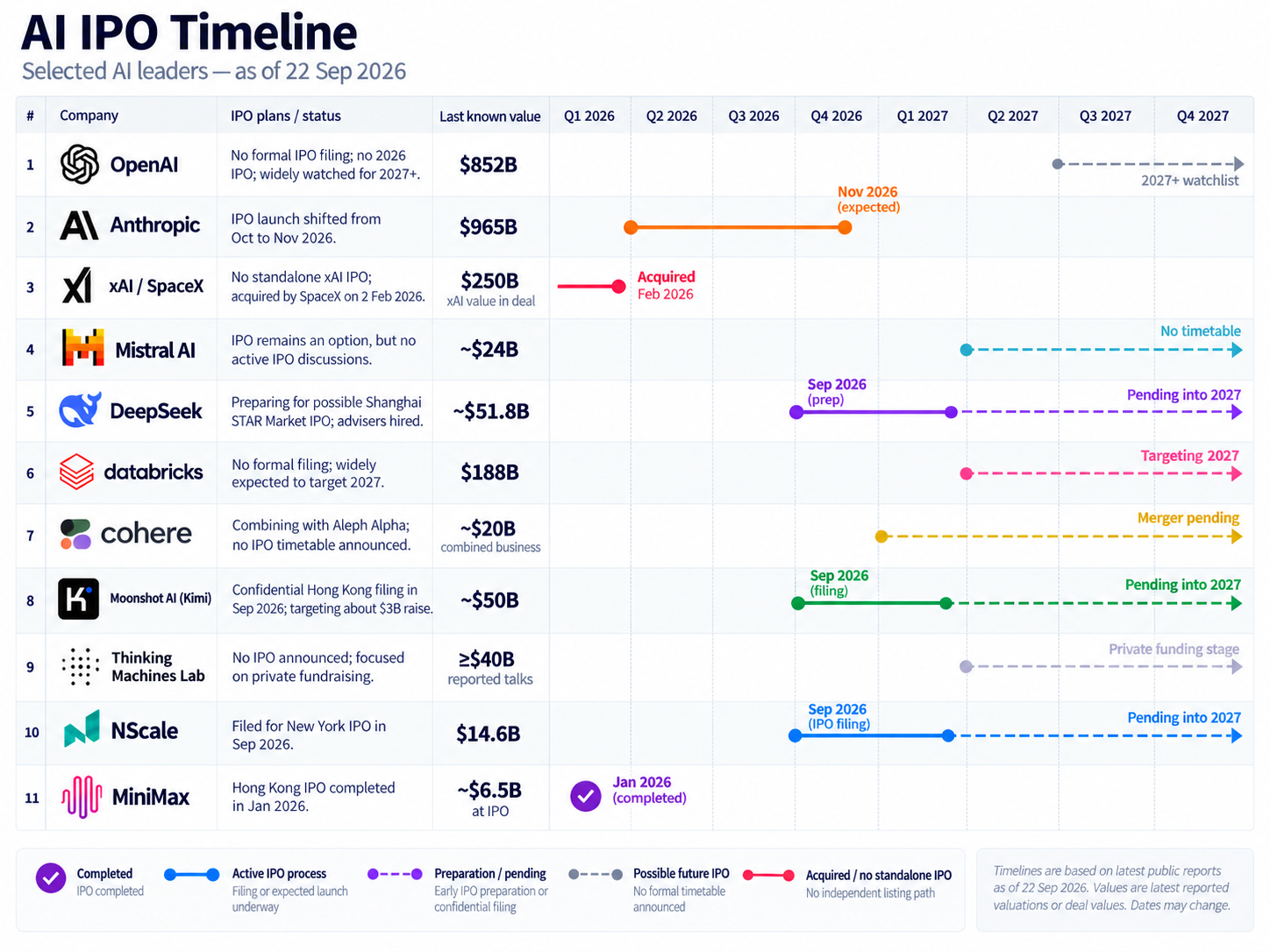
The appetite from investors is already clear. When China’s MiniMax went public in Hong Kong in January, its shares more than doubled on their first day of trading, closing 109% above the IPO price and valuing the company at around $13.7 billion.
Anthropic could take this enthusiasm to an entirely different scale. Its IPO is now reportedly expected in November, with investors discussing a valuation of around $2 trillion — more than double its most recent private valuation of $965 billion. If that happens, the message to the rest of the industry will be powerful: the public markets are willing to reward AI companies very aggressively for growth. And that could make the race for scale, compute and market dominance even harder to slow down.
The question is not whether AI can create enormous value. It almost certainly can. The question is how much risk are we are prepared to accept in the race to capture that value.
As the AI IPO pipeline starts to take shape — with Anthropic reportedly moving towards a near-term listing and other players such as Moonshot, NScale and DeepSeek also positioning themselves for public markets — the conversation should not only be about valuation, momentum and market timing. It should also be about what happens to AI governance once frontier labs are exposed to the discipline, pressure and incentives of public markets.
One of the biggest ethical questions around AI is not simply who will build the best model, but what changes when the leading companies go public. Once an AI company is listed, it no longer answers only to founders, researchers or a long-term mission. It answers to quarterly expectations and a broad base of shareholders. That creates a real risk that safety, ethics and governance become secondary to revenue growth, market share and speed.
Public-market pressure could intensify the worst incentives: launch faster, promise more, spend more aggressively, and push for growth even when the societal and safety risks remain unresolved. A listed AI company may find it harder to slow down, harder to self-regulate, and harder to prioritise caution when investors are demanding acceleration.
There is also a more structural issue. The next decade is unlikely to support an unlimited number of frontier AI companies. The current AI race is already extraordinarily capital-intensive and increasingly constrained by real-world infrastructure. Not all of them will survive. Some will consolidate, some will disappear, and some may be pushed into riskier behaviour in order to justify their valuations or preserve investor confidence. That is when ethical guardrails are most vulnerable: not only when companies are winning, but when they are under pressure.
So the ethical debate around AI IPOs goes well beyond whether these businesses are investable. It is about whether the governance of frontier AI can remain responsible once the logic of the market demands continuous expansion. If AI is as consequential as many believe, then the question is not whether these companies can go public, but whether they can do so without allowing shareholder pressure to overtake public responsibility.
So should we allow the race to the public markets to continue, or should we stop our child, tell her to chill out until an international framework for responsible AI development and governance is agreed?
At what point does “double or nothing” become too dangerous a game to play?